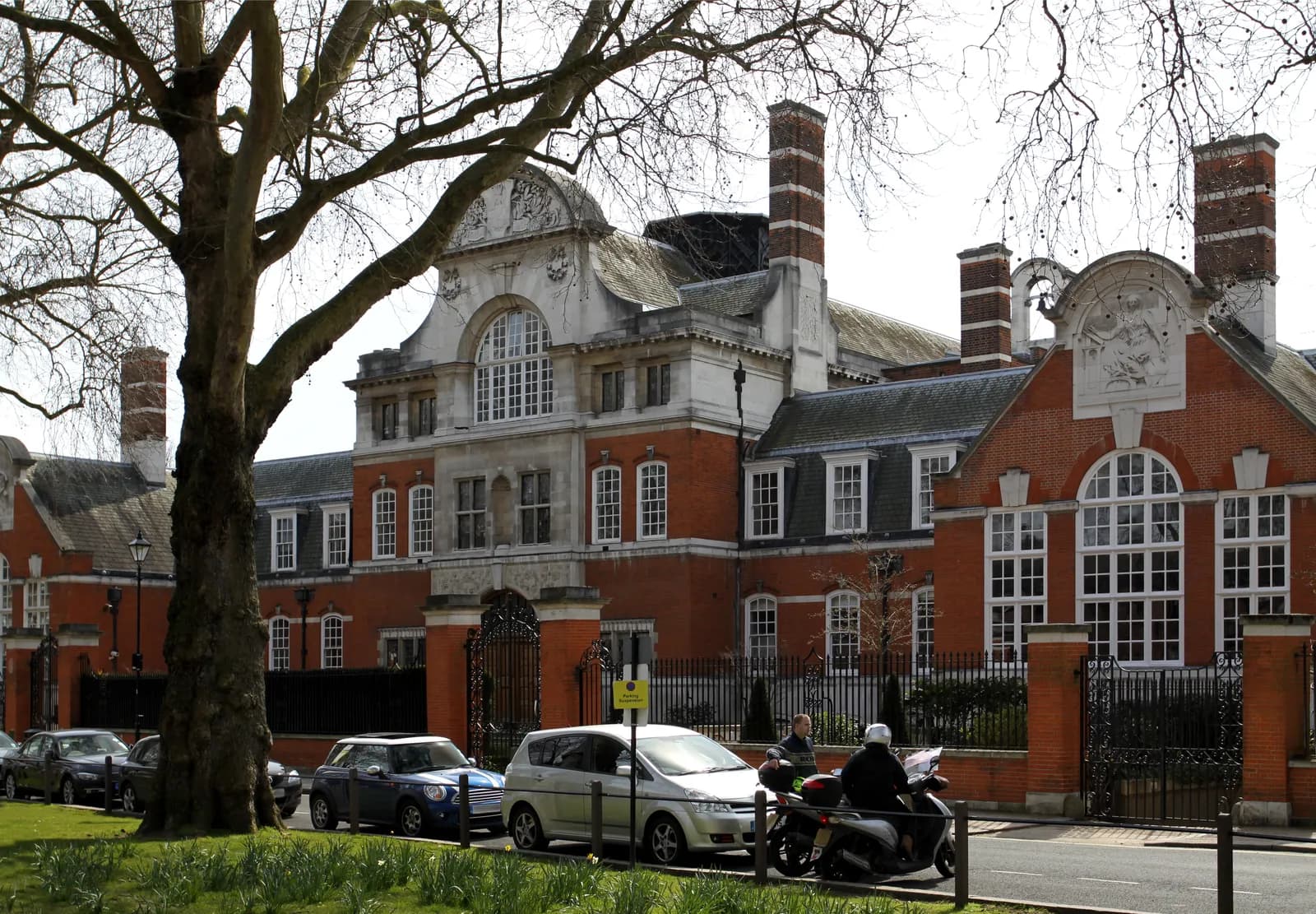
The Sound-Proof Room Where a Masterpiece Took Shape
Between 1914 and 1917, Gustav Holst composed one of the most celebrated works in the classical repertoire, "The Planets," in a sound-proof room at St Paul's Girls' School in Brook Green, Hammersmith. The seven-movement orchestral suite, which would go on to influence generations of film composers and become a staple of the concert hall, was written not in a grand studio but in a purpose-built music room at a girls' school in west London.
Holst's Hammersmith Connection
Holst had served as Director of Music at St Paul's Girls' School since 1905, two years after the school's founding by the Worshipful Company of Mercers. In 1913, the school opened a new music wing containing what Holst's biographers describe as a "sound-proof room, handsomely equipped, where he could work undisturbed." This facility proved essential to the creation of "The Planets."
That same year, Holst and his family moved to Brook Green from their previous home in Barnes. The move was motivated partly by health concerns: the river air at Barnes, frequently shrouded in fog, had aggravated Holst's asthma. The Brook Green location placed him within walking distance of the school where he would spend nearly three decades.
Holst's workload at the time was considerable. Alongside his duties at St Paul's, he served as Director of Music at Morley College from 1907 to 1924. Weekends and holidays provided his only opportunities to work on his own compositions. The sound-proof room at the school offered a rare sanctuary where he could focus entirely on the ambitious project taking shape.
The Astrological Inspiration
The idea for "The Planets" emerged during a holiday in Spain in March and April 1913, where Holst discussed astrology with the writer Clifford Bax. According to contemporary accounts, Holst became what acquaintances described as "a remarkably skilled interpreter of horoscopes" during this period. The suite would eventually comprise seven movements, each representing a planet and its corresponding astrological character.
The composition process spanned nearly three years. Holst wrote "Mars, the Bringer of War" in mid-1914, followed by "Venus, the Bringer of Peace" and "Jupiter, the Bringer of Jollity" later that year. "Saturn, the Bringer of Old Age" and "Uranus, the Magician" followed in mid-1915, with "Neptune, the Mystic" completed later that year. "Mercury, the Winged Messenger" was the final movement, written in early 1916. The orchestration was completed in 1917.
Physical Strain and Secretarial Support
The physical demands of the project were considerable. Holst suffered from chronic neuritis in his right arm, which made writing painful and laborious. The full score of "The Planets" runs to 198 pages. To complete the work, he relied upon the assistance of two colleagues at St Paul's Girls' School: Vally Lasker and Nora Day, whom he referred to as his "scribes." These women helped with the preparation of the score, enabling Holst to realise his vision despite his physical limitations.
Hammersmith in the 1910s
The Hammersmith that Holst knew was a very different place from the area today. At the time, it was a major industrial district. The Osram lamp factory operated at Brook Green, whilst the J. Lyons factory at Cadby Hall employed 30,000 people at its peak. Waring and Gillow's furniture factory in Cambridge Grove was converted to aircraft manufacture during the First World War. Hammersmith Bridge, the first suspension bridge across the Thames when it opened in 1827 and redesigned by Joseph Bazalgette in 1887, loomed nearby.
Holst was sufficiently moved by the area to compose a work specifically titled "Hammersmith" in 1930, a prelude and scherzo for military band (later arranged for orchestra) that captured his impressions of the neighbourhood. He also wrote the "Brook Green Suite" in 1933 for the school's junior orchestra, a lighter companion piece to his earlier "St Paul's Suite" (1912-13), composed for the school's string orchestra.
The Premiere and Legacy
The first complete performance of "The Planets" took place on 29 September 1918 at Queen's Hall. The circumstances were less than ideal: the musicians reportedly saw the complicated music for the first time only two hours before the performance. The off-stage chorus required for "Neptune" was recruited from Holst's students at Morley College and St Paul's Girls' School.
Holst continued as Director of Music at St Paul's until his death in 1934. The school maintains his legacy: a music room bears his name, and the institution remains one of Britain's leading independent schools for girls aged 11 to 18. The sound-proof room where he composed "The Planets" has entered musical folklore as an unlikely birthplace for a masterpiece.
Today, visitors to Brook Green can find a blue plaque commemorating Holst's connection to the school. The plaque reads simply: "Gustav Holst 1874-1934 Composer wrote The Planets and taught here." It stands as a reminder that one of classical music's most enduring works emerged from a modest schoolroom in Hammersmith, written by a composer who juggled teaching duties with artistic ambition, supported by colleagues and enabled by a sound-proof room built specifically for his use.
What Is Confirmed
The dates of composition (1914-1917), the location at St Paul's Girls' School in Brook Green, Holst's role as Director of Music from 1905-1934, the existence of the 1913 music wing with a sound-proof room, and the assistance of Vally Lasker and Nora Day are all documented in reliable sources.
What Is Unclear
The exact room within the school where Holst composed remains unspecified in available sources. A music room is named after him, but it is not confirmed whether this is the same sound-proof room used for "The Planets."