Long before the telephone, the internet, or instant messaging, a young man in Hammersmith proved that electricity could carry human thought across vast distances. Sir Francis Ronalds built the world's first working electric telegraph in the garden of his family home on Upper Mall in 1816, only to see his invention dismissed as "wholly unnecessary" by the Admiralty.
The Garden Laboratory
Ronalds was 28 years old when he set up his extraordinary experiment at what was then called "The Retreat," a Georgian mansion at 26 Upper Mall overlooking the Thames. In the garden, he laid eight miles of iron wire strung on wooden frames and insulators, looping across the lawn in an elaborate network. He also constructed a complete subterranean system in a 175-yard trench beneath the soil.
The apparatus used electrostatic generators to send electrical pulses along the wires. At both ends of the line, Ronalds installed revolving dials marked with the letters of the alphabet; electrical impulses transmitted messages by indicating specific letters. He discovered that the signal travelled "immeasurably fast from one end to the other," and even predicted the risk of signal retardation due to induction, a problem that would later plague submarine cable telegraphy decades later.
A Vision of the Future
Ronalds was not merely demonstrating a scientific curiosity; he understood the revolutionary potential of his invention. In his 1823 publication, "Descriptions of an Electrical Telegraph and of some other Electrical Apparatus," he wrote: "electricity, may actually be employed for a more practically useful purpose than the gratification of the philosopher's inquisitive research… it may be compelled to travel… many hundred miles beneath our feet."
He went further, envisioning what he called "electrical conversazione offices" that would communicate with each other "all over the kingdom" to eliminate the "dilatory tormentors, pens, ink, paper, and posts." His description essentially predicted the entire Victorian telegraph network that would emerge two decades later.
The Rejection
In July 1816, Ronalds offered his invention to the British Admiralty. On 5 August that year, Sir John Barrow, Secretary at the Admiralty, rejected it as being "wholly unnecessary." The existing optical telegraph, which used semaphore signals to connect London to Portsmouth, was deemed adequate for the nation's needs.
The dismissal would prove shortsighted. Ronalds' telegraph predated the commercial systems developed by William Fothergill Cooke and Charles Wheatstone by more than 20 years, and elements of his design were eventually utilised when electric telegraphy was finally commercialised in the 1840s.
Recognition Delayed
Ronalds possessed what contemporaries described as a "very modest and retiring nature." He did little to publicise his work during his lifetime, and recognition came late. He was knighted in 1870 at the age of 82, specifically for creating the first working electric telegraph over a substantial distance. The Society of Telegraph Engineers would later regard him as "the father of electric telegraphy."
He went on to establish the Kew Observatory in 1842, invent the first successful continuously recording camera in 1845, and develop instruments for monitoring atmospheric electricity and geomagnetic force that were used at observatories worldwide until the late 20th century.
What Remains in Hammersmith
The house at 26 Upper Mall still stands today, a Grade II* listed building now known as Kelmscott House. It is best known as the home of William Morris, the Arts and Crafts designer who lived there from 1878 until his death in 1896 and gave the house its current name.
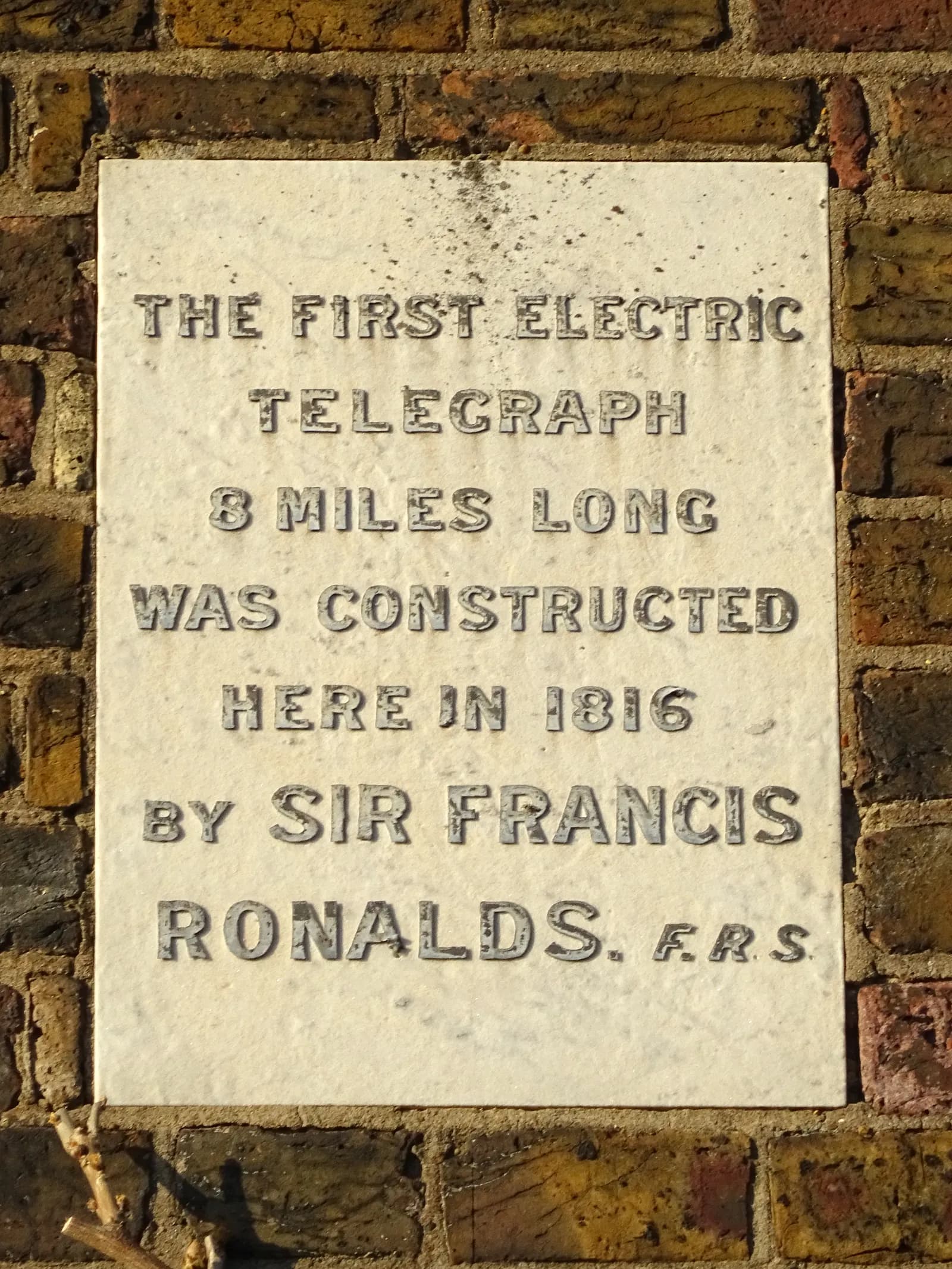
A commemorative plaque is fixed to the coach house, which now serves as headquarters of the William Morris Society. The inscription reads: "The first electric telegraph 8 miles long was constructed here in 1816 by Sir Francis Ronalds. F.R.S." The building is open to the public on Thursday and Saturday afternoons.
The site represents a remarkable convergence of British intellectual history: the birthplace of electric telegraphy, the residence of the Victorian novelist George MacDonald, and the home of William Morris. Few locations in London can claim to encapsulate three such distinct eras of innovation in a single building.